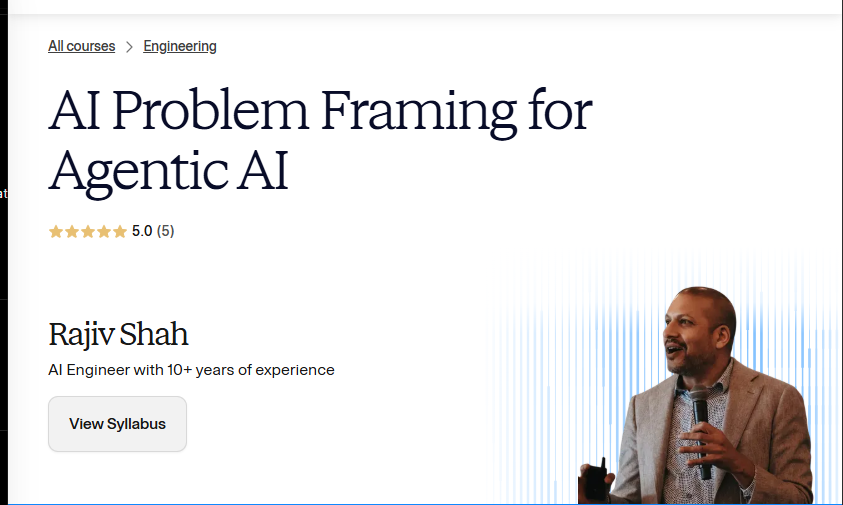
Rajiv Shah – AI Problem Framing for Agentic AI
$980.00 Original price was: $980.00.$45.00Current price is: $45.00.

Rajiv Shah – AI Problem Framing for Agentic AI
Introduction
Artificial Intelligence is no longer limited to simple prediction models or automation scripts. The rise of agentic AI systems—AI that can act autonomously, make decisions, and execute tasks—has completely changed how we approach problem-solving. However, one critical factor still determines whether an AI system succeeds or fails: problem framing.
Many businesses jump straight into building AI solutions without clearly defining the problem. This leads to wasted resources, poor outputs, and systems that don’t deliver real value. The concept behind Rajiv Shah – AI Problem Framing for Agentic AI focuses on solving this exact issue—teaching how to properly define, structure, and optimize problems so AI agents can perform effectively.
This guide explores deep insights, frameworks, and strategies to help you master problem framing in the context of modern AI systems.
What is AI Problem Framing?
AI problem framing is the process of clearly defining:
- The goal of the system
- The inputs it receives
- The decisions it must make
- The expected outputs
In simple terms, it is about asking the right question before building the solution.
A poorly framed problem results in:
- Confusing AI behavior
- Inefficient workflows
- Unreliable outputs
A well-framed problem leads to:
- Accurate results
- Scalable systems
- Better automation
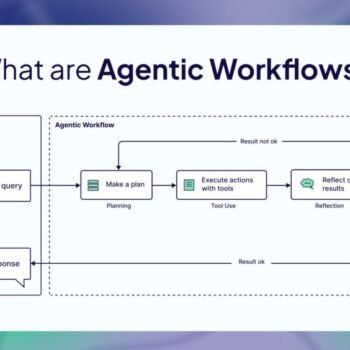
Understanding Agentic AI
Agentic AI refers to systems that:
- Operate independently
- Make decisions based on context
- Take actions toward achieving goals
Examples include:
- Autonomous customer support bots
- AI research assistants
- Workflow automation agents
- Multi-agent collaboration systems
Unlike traditional AI, agentic systems don’t just respond—they plan, decide, and act.
Why Problem Framing Matters More in Agentic AI
Agentic AI amplifies both strengths and weaknesses. If the problem is unclear, the system will:
- Misinterpret goals
- Take incorrect actions
- Produce inconsistent outcomes
This is because agentic AI relies heavily on:
- Context understanding
- Goal clarity
- Decision boundaries
Without proper framing, even the most advanced AI models fail.
Core Principles of Effective Problem Framing
1. Define the Objective Clearly
Start with a precise goal. Avoid vague instructions.
Bad Example:
“Improve customer experience”
Good Example:
“Reduce customer response time to under 2 minutes using automated replies”
2. Break Problems into Subtasks
Agentic systems perform better when tasks are modular.
Instead of:
- One large, complex task
Use:
- Smaller, manageable components
This improves:
- Accuracy
- Debugging
- Scalability
3. Identify Inputs and Outputs
Every AI system needs clear data boundaries.
Ask:
- What data goes in?
- What should come out?
This prevents ambiguity and improves performance.
4. Set Constraints and Rules
Define what the AI should not do.
Examples:
- Avoid generating incorrect data
- Stick to verified sources
- Follow ethical guidelines
Constraints guide decision-making and prevent errors.
5. Include Feedback Loops
Agentic AI improves with iteration.
Add mechanisms for:
- Self-correction
- Human feedback
- Continuous learning
Framework for AI Problem Framing
Here’s a practical framework you can apply:
Step 1: Problem Definition
Write the problem in one sentence.
Step 2: Goal Specification
Define measurable outcomes.
Step 3: Task Decomposition
Break into smaller tasks.
Step 4: Input/Output Mapping
List all inputs and expected outputs.
Step 5: Constraints Setup
Define limitations and rules.
Step 6: Evaluation Metrics
Decide how success will be measured.
Real-World Example
Scenario: AI Content Generator
Poorly Framed Problem:
“Create blog content”
Well-Framed Problem:
“Generate a 1500-word SEO-optimized blog post with headings, meta description, and keyword density under 2%”
See the difference? The second version gives:
- Clear instructions
- Defined output
- Measurable success
Common Mistakes in Problem Framing
1. Being Too Vague
Unclear goals confuse AI systems.
2. Overloading the System
Too many tasks at once reduce performance.
3. Ignoring Constraints
Without boundaries, AI may produce irrelevant or incorrect outputs.
4. Lack of Evaluation Metrics
If you can’t measure success, you can’t improve.
Advanced Techniques for Better Framing
1. Chain-of-Thought Structuring
Guide AI through step-by-step reasoning.
2. Role-Based Framing
Assign a role to the AI.
Example:
“You are an expert SEO writer…”
This improves output quality significantly.
3. Multi-Agent Task Distribution
Instead of one AI doing everything:
- Use multiple agents
- Assign specific roles
Example:
- Research agent
- Writing agent
- Editing agent
4. Iterative Refinement
Don’t expect perfection in one go.
Improve by:
- Testing
- Adjusting
- Reframing
Benefits of Proper AI Problem Framing
- Higher accuracy
- Faster execution
- Better scalability
- Reduced costs
- Improved user experience
Applications Across Industries
1. Marketing
- Content generation
- Campaign optimization
2. Healthcare
- Diagnosis assistance
- Patient data analysis
3. Finance
- Fraud detection
- Risk assessment
4. E-commerce
- Personalized recommendations
- Customer support automation
Future of Agentic AI and Problem Framing
As AI evolves, problem framing will become even more important. Future systems will:
- Handle complex decision-making
- Operate with minimal supervision
- Collaborate with other AI agents
In this landscape, those who master problem framing will have a significant advantage.
Practical Tips to Get Started
- Always start with clarity
- Write down the problem before coding
- Test small, then scale
- Continuously refine your approach
Conclusion
AI is powerful, but its effectiveness depends on how well the problem is defined. The concept behind Rajiv Shah – AI Problem Framing for Agentic AI highlights a critical truth: success in AI doesn’t start with algorithms—it starts with clarity.
By focusing on structured problem definition, clear goals, and thoughtful design, you can build AI systems that are not only intelligent but also reliable and scalable.
Mastering problem framing is not optional anymore—it’s essential.