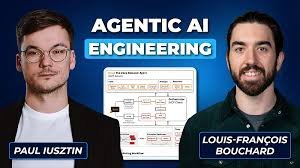
Paul Iusztin – Agentic AI Engineering
$449.00 Original price was: $449.00.$49.00Current price is: $49.00.

Paul Iusztin – Agentic AI Engineering
Artificial intelligence is evolving rapidly, and the next frontier is not just smart models but autonomous AI agents capable of planning, reasoning, and executing complex workflows. This is where Paul Iusztin – Agentic AI Engineering stands out as a structured and practical framework for building real-world AI systems that go beyond simple prompt-response interactions.
In this in-depth guide, we explore the philosophy, features, practical applications, tutorial insights, and frequently asked questions related to Paul Iusztin – Agentic AI Engineering. Whether you’re looking for a review, installation guidance, or the latest version updates, this article provides a comprehensive overview designed for developers, founders, and AI enthusiasts.
Who Is Paul Iusztin?
Paul Iusztin is widely recognized in the AI engineering space for his educational contributions and practical approach to applied artificial intelligence. His focus lies in bridging the gap between theoretical machine learning and production-ready AI systems.
Rather than focusing purely on model training, he emphasizes:
Engineering best practices
System architecture design
Agentic workflows
Real-world deployment strategies
Scalable AI infrastructure
This philosophy forms the foundation of Paul Iusztin – Agentic AI Engineering, a framework centered around building autonomous, goal-driven AI systems.
What Is Agentic AI Engineering?
Agentic AI refers to AI systems that:
Set goals
Plan tasks
Use tools
Iterate over results
Make decisions with limited human input
Traditional AI systems respond to prompts. Agentic AI systems act.
Paul Iusztin – Agentic AI Engineering focuses on designing AI architectures that combine:
Large language models (LLMs)
Memory systems
Tool integration
Retrieval mechanisms
Decision loops
Monitoring and evaluation frameworks
The goal is to move from simple chatbot interactions to production-grade autonomous AI agents.
Core Philosophy Behind Paul Iusztin – Agentic AI Engineering
The framework is built around five core pillars:
1. Systems Over Prompts
Instead of relying on clever prompts, the methodology encourages designing robust systems with:
Clear task decomposition
Modular components
Error handling
Evaluation loops
2. Production-Ready Mindset
Agentic systems must be:
Secure
Scalable
Observable
Maintainable
This engineering-first mindset separates hobby experiments from real business applications.
3. Tool-Augmented Agents
Modern AI agents require access to tools such as:
Search APIs
Databases
Code execution environments
External services
Paul Iusztin – Agentic AI Engineering emphasizes building agents that can interact with real-world systems effectively.
4. Memory and Context Management
Long-term memory is critical for:
Personalization
Multi-step reasoning
Project continuity
Context-aware automation
5. Continuous Evaluation
Autonomous agents must be evaluated consistently to prevent:
Hallucinations
Logic errors
Task drift
Unsafe behavior
Key Features of Paul Iusztin – Agentic AI Engineering
If you’re searching for a detailed review of Paul Iusztin – Agentic AI Engineering, here are the standout features:
Modular Agent Architecture
Planner module
Executor module
Memory store
Tool registry
Feedback loop
Real-World Deployment Strategies
Cloud deployment patterns
Containerization concepts
API integration
Monitoring and logging
Practical Tutorials
Step-by-step agent building
Multi-agent systems
Tool integration examples
RAG (Retrieval-Augmented Generation) implementation
Scalability Guidance
Performance optimization
Cost control
Parallel agent execution
Resource management
Security Considerations
Tool permission management
Input validation
API key protection
Safe execution environments
Paul Iusztin – Agentic AI Engineering Tutorial Overview
For learners looking for a tutorial approach, the methodology typically includes:
Step 1: Understanding LLM Capabilities
Before building agents, you must understand:
Token limits
Context windows
Strengths and weaknesses
Step 2: Designing the Agent Loop
An agent loop usually includes:
Observe
Plan
Act
Reflect
Repeat
Step 3: Integrating Tools
Agents gain power when connected to:
Web search
Databases
Internal APIs
Automation scripts
Step 4: Adding Memory
Memory systems can include:
Vector databases
Long-term logs
Context caching
Step 5: Monitoring and Optimization
Track:
Latency
Cost
Accuracy
Task completion rate
This systematic approach is what makes Paul Iusztin – Agentic AI Engineering stand out in practical AI development.
Use Cases of Agentic AI Engineering
1. Autonomous Research Assistants
Agents that:
Gather data
Summarize insights
Generate reports
Validate sources
2. AI-Powered Customer Support
Multi-step ticket resolution
Knowledge base retrieval
Escalation handling
3. Automated Content Pipelines
Topic research
Draft generation
SEO optimization
Publishing automation
4. Developer Productivity Agents
Code generation
Debugging assistance
Documentation writing
Pull request analysis
5. Business Process Automation
Data extraction
Workflow orchestration
Financial reporting
Latest Version and Updates
When exploring the latest version of Paul Iusztin – Agentic AI Engineering, the focus continues to evolve around:
Multi-agent collaboration
Improved tool routing
Enhanced memory optimization
Advanced evaluation metrics
Cost-aware architecture
The framework adapts as AI capabilities improve, ensuring engineers stay aligned with industry best practices.
Installation and Implementation Guide
While Agentic AI Engineering is more of a framework than a single downloadable software product, implementing it typically involves:
Requirements:
Python environment
LLM API access
Vector database (optional)
Tool integrations
Basic Installation Flow:
Set up Python virtual environment
Install required AI libraries
Configure API keys
Build agent modules
Connect tools
Test with evaluation framework
Searching for “Paul Iusztin – Agentic AI Engineering install guide” often leads to structured implementation walkthroughs designed for engineers.
Free vs Paid Access and Download Considerations
Many users search for:
Paul Iusztin – Agentic AI Engineering free download
Paul Iusztin – Agentic AI Engineering latest version
Paul Iusztin – Agentic AI Engineering online access
Paul Iusztin – Agentic AI Engineering crack
It is important to clarify that engineering frameworks and educational resources should always be accessed legally and ethically. Instead of looking for unofficial downloads or crack versions, it is advisable to use authorized materials and official resources to ensure security, accuracy, and up-to-date information.
Why Agentic AI Engineering Matters in 2026 and Beyond
The AI industry is shifting from:
Prompt Engineering → System Engineering
Businesses now require:
Reliable automation
Cost efficiency
Enterprise-grade security
Scalable architecture
Paul Iusztin – Agentic AI Engineering addresses this shift by equipping developers with:
Structured methodologies
Production-level thinking
Practical architectural patterns
This makes it highly relevant for:
AI startups
SaaS companies
Enterprise automation teams
Independent developers
Advantages of Paul Iusztin – Agentic AI Engineering
Clear engineering-first framework
Real-world applicability
Focus on scalability
Emphasis on evaluation and safety
Future-proof architecture
Potential Challenges
Like any advanced engineering framework, it requires:
Strong Python knowledge
Understanding of APIs
Familiarity with LLM behavior
Systems thinking mindset
However, the structured approach significantly reduces trial-and-error experimentation.
Final Verdict
Agentic AI represents the next evolutionary step in artificial intelligence systems. Instead of simply responding to instructions, modern AI must reason, plan, and execute autonomously.
Paul Iusztin – Agentic AI Engineering offers a structured and production-focused pathway for achieving this transformation. By combining modular architecture, evaluation loops, tool integrations, and scalable deployment practices, it provides a comprehensive blueprint for building intelligent, autonomous systems that operate effectively in real-world environments.
For developers, entrepreneurs, and AI professionals looking to move beyond experimentation into scalable AI product development, this framework serves as a powerful foundation.