
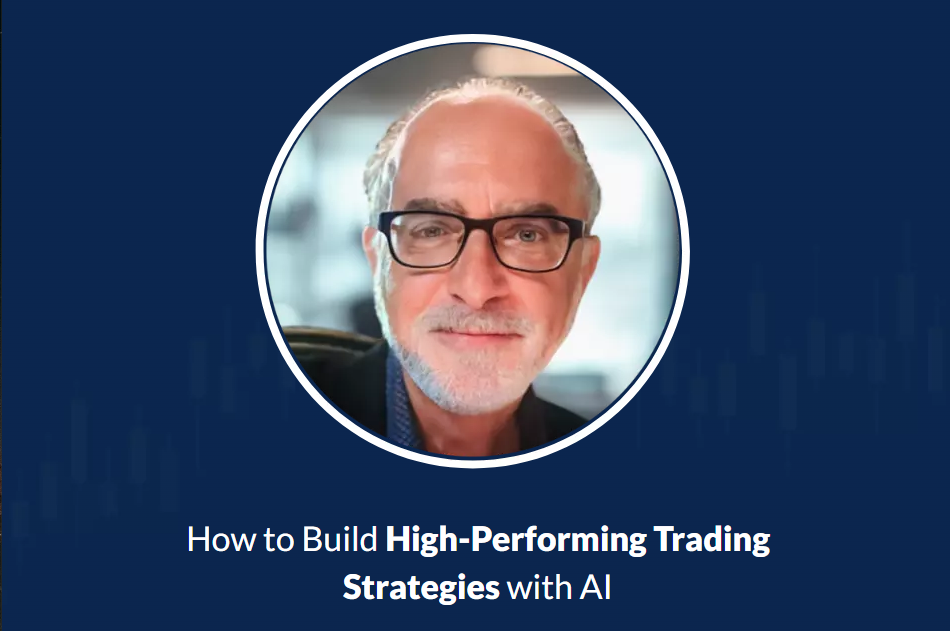

Larry Connors – How To Build High-Performing Trading Strategies With AI
Introduction
The financial markets are evolving at an unprecedented pace. Traditional chart patterns, discretionary trading, and intuition-based decision-making are gradually being replaced by data-driven methodologies powered by artificial intelligence. In this new era, Larry Connors – How To Build High-Performing Trading Strategies With AI represents a powerful framework for traders who want to combine proven quantitative principles with modern AI tools to gain a sustainable edge.
Larry Connors has long been recognized as one of the pioneers in short-term quantitative trading and mean reversion strategies. By integrating artificial intelligence into systematic trading approaches, traders can dramatically improve strategy robustness, efficiency, and scalability. This guide explores how AI enhances trading systems, how to build high-performance strategies step-by-step, and how disciplined execution transforms data into consistent profits.
Who Is Larry Connors?
Larry Connors is a respected quantitative trader, author, and educator known for his research-driven trading methodologies. Over the years, he has developed and shared strategies based on statistical edges rather than speculation. His work focuses on short-term trading systems, mean reversion setups, and rigorous backtesting.
The philosophy behind Larry Connors – How To Build High-Performing Trading Strategies With AI builds on three pillars:
Data-driven decision making
Statistical validation
Systematic execution
Instead of predicting markets, the focus is on identifying repeatable patterns backed by historical evidence.
Why AI Is Transforming Trading
Artificial intelligence changes how traders process data and generate insights. Traditional strategies rely on predefined indicators and fixed rules. AI, on the other hand, analyzes vast datasets to uncover patterns that may not be visible through manual analysis.
Key Advantages of AI in Trading
Rapid processing of large historical datasets
Identification of complex, non-linear relationships
Continuous learning and adaptation
Reduction of emotional bias
Optimization of parameters with precision
When combined with quantitative foundations, AI becomes a powerful enhancement tool rather than a replacement for disciplined trading logic.
Core Principles of High-Performing Trading Strategies
Before integrating AI, it is essential to understand what makes a trading strategy truly high-performing.
1. Statistical Edge
A strategy must demonstrate a positive expectancy over a large sample size. This requires thorough backtesting and validation across different market conditions.
2. Risk Management
Position sizing, drawdown control, and capital allocation determine long-term survival. Even the most advanced AI model fails without risk discipline.
3. Simplicity and Clarity
Complexity does not guarantee profitability. Many of the most successful strategies are simple but statistically robust.
4. Consistency
Systematic execution ensures that the edge is realized over time.
These principles form the backbone of Larry Connors – How To Build High-Performing Trading Strategies With AI, where technology enhances structured logic instead of replacing it.
Step-by-Step Guide to Building AI-Driven Trading Strategies
Step 1: Define the Market and Timeframe
Start by selecting the asset class:
Stocks
ETFs
Futures
Forex
Cryptocurrencies
Next, determine the timeframe:
Intraday
Swing trading
Short-term mean reversion
Multi-day momentum
Clarity at this stage ensures focused data collection and accurate model training.
Step 2: Collect and Prepare Data
Data quality directly impacts model performance. Gather:
Historical price data
Volume data
Volatility metrics
Market breadth indicators
Fundamental data (if required)
Clean the dataset by removing errors, adjusting for splits, and ensuring consistent formatting. AI models require structured, accurate input.
Step 3: Identify Hypotheses
Rather than randomly applying AI, begin with a hypothesis. For example:
Stocks tend to revert after extreme short-term declines.
Volatility spikes create short-term mean reversion opportunities.
Momentum persists in strong trending environments.
AI can test, refine, and optimize these hypotheses at scale.
Step 4: Feature Engineering
Feature engineering transforms raw data into meaningful inputs. Examples include:
RSI values
Moving averages
Volatility bands
Price change percentages
Relative strength rankings
The stronger the features, the better the AI model performs.
Step 5: Model Selection
Common AI and machine learning techniques used in trading include:
Linear regression
Random forests
Gradient boosting
Neural networks
Reinforcement learning
The key is not complexity but predictive accuracy and stability.
Step 6: Backtesting and Validation
Backtesting evaluates strategy performance on historical data. However, proper validation requires:
Out-of-sample testing
Walk-forward analysis
Monte Carlo simulations
Avoid curve-fitting at all costs. A strategy that performs well only in past data but fails in unseen conditions is not reliable.
Step 7: Risk Optimization
AI can optimize:
Stop-loss levels
Profit targets
Position sizing rules
Portfolio diversification
Risk-adjusted returns matter more than raw profitability.
Mean Reversion and AI: A Powerful Combination
Larry Connors is particularly known for short-term mean reversion strategies. AI enhances these strategies by:
Detecting extreme conditions more precisely
Adjusting thresholds dynamically
Filtering trades based on market regime
Instead of static RSI levels, AI can determine adaptive entry signals based on volatility and market behavior.
This approach exemplifies how Larry Connors – How To Build High-Performing Trading Strategies With AI merges classic quantitative logic with modern machine learning adaptability.
Avoiding Common Pitfalls
Overfitting
When a model is excessively optimized to historical data, it loses predictive power. Always prioritize robustness over perfection.
Ignoring Transaction Costs
Slippage and commissions significantly impact short-term systems. AI models must incorporate realistic assumptions.
Emotional Interference
Even automated systems require disciplined oversight. Avoid overriding signals based on fear or excitement.
Performance Metrics That Matter
When evaluating AI trading strategies, focus on:
Win rate
Average win vs average loss
Maximum drawdown
Sharpe ratio
Profit factor
Expectancy
A balanced strategy with controlled drawdowns is preferable to high returns with extreme volatility.
The Role of Automation
Automation ensures consistent execution. AI-generated signals can be connected to trading platforms via APIs, enabling:
Instant order execution
Real-time monitoring
Dynamic portfolio rebalancing
Automation reduces human error and increases efficiency.
Psychological Edge in Systematic Trading
Although AI handles data analysis, psychology still matters. Traders must:
Trust the system during drawdowns
Avoid constant parameter adjustments
Follow predefined risk rules
High-performing strategies require patience and discipline.
Real-World Application Framework
To apply the principles behind Larry Connors – How To Build High-Performing Trading Strategies With AI, follow this structured workflow:
Identify a statistically sound trading concept
Build structured datasets
Engineer meaningful features
Train AI models carefully
Validate across multiple market conditions
Optimize risk exposure
Deploy gradually with small capital
Monitor and refine responsibly
This structured process ensures that AI enhances performance rather than introducing unnecessary complexity.
Future of AI in Trading
Artificial intelligence will continue to evolve, incorporating:
Real-time sentiment analysis
Alternative data sources
Adaptive regime detection
Multi-asset portfolio intelligence
However, the foundation remains unchanged: strong statistical principles combined with disciplined execution.
Final Thoughts
The financial markets reward preparation, discipline, and innovation. By combining quantitative expertise with artificial intelligence, traders can create powerful, scalable systems. Larry Connors – How To Build High-Performing Trading Strategies With AI is not just about technology; it is about structured thinking, data-driven decisions, and relentless optimization.
High-performing strategies are built through rigorous research, thorough validation, and controlled risk management. AI accelerates discovery and enhances precision, but success ultimately depends on disciplined execution.
Traders who embrace systematic methods, continuously refine their models, and respect market uncertainty position themselves for long-term growth in an increasingly competitive environment.
The fusion of quantitative strategy design and artificial intelligence represents the next evolution of professional trading.