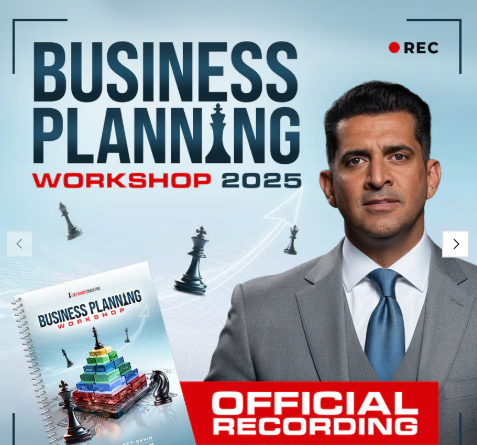
Patrick Bet-David – Business Planning Workshop 2025
$327.00 Original price was: $327.00.$45.00Current price is: $45.00.

Introduction: Why Business Planning Matters More Than Ever in 2025
The modern business environment is evolving at an unprecedented pace. Artificial intelligence, remote workforces, global competition, decentralized finance, and creator-driven economies are reshaping how companies are launched, scaled, and sustained. In such an unpredictable ecosystem, long-term success is no longer built on passion alone; it is built on planning, clarity, and disciplined execution.
This is exactly where Patrick Bet-David – Business Planning Workshop 2025 positions itself as a powerful learning platform. Known worldwide for his direct communication style, sharp business insights, and uncompromising focus on execution, Patrick Bet-David has created a workshop experience that goes far beyond traditional motivational events. Instead, it emphasizes strategic frameworks, decision-making models, leadership psychology, and practical business architecture.
This guide explores the workshop’s core themes, expected structure, strategic value, and the mindset shift it encourages for entrepreneurs, CEOs, startup founders, and business leaders navigating 2025 and beyond.
Who Is Patrick Bet-David and Why His Planning Philosophy Stands Out
Patrick Bet-David is widely recognized as a modern entrepreneurial educator who blends real-world experience with high-performance thinking. As the founder of Valuetainment and a successful business leader, he built his reputation not by selling theory, but by analyzing how power, economics, leadership, and organizational behavior intersect.
What separates his approach from conventional business training is the emphasis on:
Strategic foresight rather than short-term hustle
Leadership architecture instead of surface-level motivation
Systems and scalability over scattered productivity
Personal discipline as a business growth multiplier
The philosophy behind Patrick Bet-David – Business Planning Workshop 2025 revolves around constructing a business as if it were a nation: with structure, culture, infrastructure, leadership hierarchies, and economic logic that can survive pressure, competition, and crisis.
The Core Purpose of the Workshop
At its heart, the workshop is designed to help participants build businesses that are:
Intentionally designed rather than emotionally driven
Scalable rather than dependent on a single individual
Strategically positioned rather than opportunistic
Execution-focused rather than idea-heavy
Rather than teaching attendees what business to start, the program focuses on how to think as a strategic architect. Participants are guided to define what game they are playing, what market position they want to own, and what long-term outcomes they are building toward.
This makes the experience particularly valuable for founders who have already started their journey but feel stuck, scattered, or unclear about their next phase of growth.
Strategic Vision: Designing the Future Before It Arrives
One of the most emphasized components of the workshop is vision engineering. Instead of vague goal-setting, the program explores how to:
Define a 5-year and 10-year organizational vision
Reverse-engineer annual, quarterly, and monthly objectives
Align personal ambition with business direction
Identify what kind of company must be built to support that vision
Participants are encouraged to design their future in detail: market position, leadership team structure, product ecosystem, revenue streams, and even brand influence. This strategic clarity forms the foundation for every planning model introduced throughout the workshop.
Within Patrick Bet-David – Business Planning Workshop 2025, vision is treated not as inspiration, but as infrastructure.
Business Architecture: Building Companies That Outlive Founders
Another major pillar of the workshop is business architecture. This section focuses on constructing organizations that can scale without chaos.
Topics explored typically include:
Organizational design and departmental structure
Leadership pipelines and succession thinking
Operational systems and accountability frameworks
Cultural development and internal values
Performance measurement models
Rather than operating as freelancers with staff, attendees learn to think like institution builders. The emphasis is on creating companies that can expand into new markets, absorb competition, survive downturns, and continue functioning without the founder micromanaging every process.
This architectural mindset is one of the defining features of Patrick Bet-David – Business Planning Workshop 2025, separating it from generic business seminars.
Decision-Making Frameworks in High-Pressure Environments
Modern leaders face a constant stream of decisions involving hiring, capital, partnerships, branding, and market positioning. Poor decisions scale faster than good ones, and emotional reactions often create long-term damage.
The workshop addresses this by introducing strategic decision-making frameworks designed to:
Evaluate opportunities through long-term lenses
Distinguish between ego-driven and data-driven moves
Analyze risk, timing, and competitive positioning
Structure thinking during moments of uncertainty
Participants are trained to slow down their thinking while speeding up execution. Instead of reacting to trends, they learn how to evaluate power dynamics, market cycles, and organizational readiness before committing resources.
Execution Systems: Turning Strategy Into Daily Reality
Vision without execution becomes entertainment. Planning without accountability becomes intellectual comfort. This is why a significant portion of the workshop is dedicated to building execution engines.
Key elements include:
Translating annual plans into operational roadmaps
Establishing weekly and quarterly performance systems
Designing scorecards and leadership accountability loops
Aligning teams around measurable outcomes
Identifying bottlenecks that silently kill growth
Within Patrick Bet-David – Business Planning Workshop 2025, execution is framed as culture, not pressure. When properly designed, execution becomes automatic because the environment demands performance through structure, clarity, and ownership.
Leadership Psychology and Power Dynamics
Beyond numbers and systems, the workshop places heavy emphasis on leadership psychology. Businesses do not fail because of spreadsheets; they fail because of people, ego, fear, miscommunication, and misaligned incentives.
This segment typically explores:
Founder psychology under scale
Managing internal politics and power shifts
Building leadership loyalty and trust
Conflict management inside fast-growing organizations
Creating cultures that reward responsibility
Participants are challenged to analyze not only their business models, but also their personal leadership identity. They are encouraged to confront blind spots, emotional triggers, and management habits that may be limiting growth.
Market Positioning and Long-Term Competitive Strategy
A strong business plan is incomplete without market dominance strategy. The workshop addresses how to:
Define a company’s strategic identity
Identify market gaps and competitive leverage
Position brands for influence, not just sales
Build ecosystems rather than single-product companies
Anticipate industry shifts before they occur
Instead of chasing short-term revenue, the planning process focuses on building enterprises that own categories, control narratives, and establish long-term relevance.
This is one of the areas where Patrick Bet-David – Business Planning Workshop 2025 becomes particularly valuable for founders who want to move from survival mode into legacy construction.
The Entrepreneurial Mindset Shift
Perhaps the most transformative outcome of the workshop is not tactical knowledge, but mindset recalibration. Attendees are encouraged to evolve from:
Operators into architects
Hustlers into strategists
Managers into institution builders
Revenue chasers into market leaders
This shift forces participants to reevaluate how they allocate time, build teams, define success, and measure progress. The workshop emphasizes that sustainable growth is not created by doing more, but by designing better systems.
Who Should Attend This Workshop
The workshop is especially relevant for:
Startup founders preparing to scale
CEOs seeking organizational clarity
Entrepreneurs facing stagnation
Business owners restructuring operations
Leaders building multi-division enterprises
Professionals transitioning into executive roles
Because Patrick Bet-David – Business Planning Workshop 2025 integrates leadership psychology, strategic architecture, and execution systems, it serves both early-stage founders and experienced operators.
Long-Term Value of Strategic Business Planning
Strategic planning is not about predicting the future; it is about preparing for multiple futures. Businesses that survive economic shifts, technological disruption, and competitive pressure are those built on intentional design.
Participants leave the workshop not with motivational highs, but with:
Structured planning methodologies
Organizational clarity
Decision-making discipline
Leadership frameworks
Long-term growth orientation
These assets compound over time, improving not only revenue outcomes, but also leadership confidence and organizational stability.
Final Thoughts
In a business era dominated by speed, distraction, and surface-level success, deep planning has become a rare competitive advantage. Workshops that emphasize architecture, psychology, execution, and strategic foresight hold exceptional value.
Patrick Bet-David – Business Planning Workshop 2025 stands as a platform that challenges entrepreneurs to stop improvising their future and start engineering it. By focusing on long-term vision, organizational design, leadership mastery, and disciplined execution, the workshop aligns business ambition with structural intelligence.
For those serious about building companies that last, influence markets, and evolve beyond their founders, this workshop represents not just an event, but a strategic turning point.