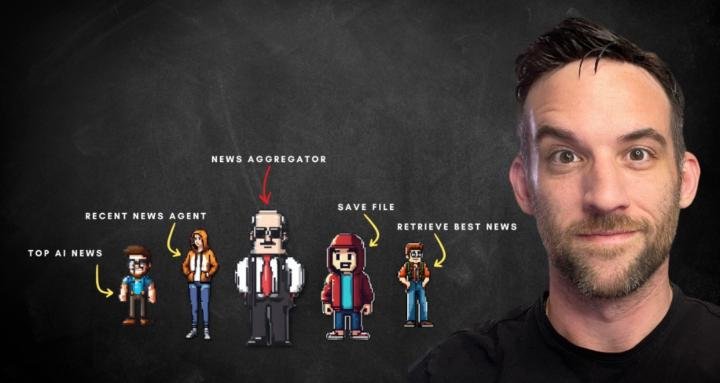
Tyler Reed – The AI Agent
$37.00 Original price was: $37.00.$16.00Current price is: $16.00.

Tyler Reed – The AI Agent
Introduction: The New Era of AI-Driven Intelligence
Artificial intelligence has moved far beyond simple automation and scripted responses. Today, AI systems can reason, adapt, plan, and act independently across complex environments. At the center of this transformation is Tyler Reed – The AI Agent, a concept that represents how modern AI agents are designed to think, execute tasks, and deliver value at scale.
Unlike traditional AI tools that respond only when prompted, advanced agents operate continuously, learning from data, making decisions, and optimizing workflows without constant human intervention. This evolution is reshaping industries such as marketing, finance, healthcare, customer service, and software development. Understanding how this agent-based intelligence works is essential for anyone looking to stay competitive in a rapidly changing digital landscape.
Understanding AI Agents: What Makes Them Different?
AI agents are autonomous systems designed to perceive their environment, analyze information, and take action to achieve predefined goals. What sets them apart is their ability to combine reasoning, memory, and execution into a single intelligent loop.
Core Characteristics of Modern AI Agents
Autonomy: Operate independently without continuous human input
Context Awareness: Understand goals, constraints, and changing conditions
Decision-Making Ability: Evaluate multiple outcomes before acting
Learning Capability: Improve performance over time using feedback
Tool Integration: Interact with APIs, databases, and software platforms
These capabilities allow AI agents to function more like digital professionals rather than simple software programs.
The Vision Behind Tyler Reed – The AI Agent
Tyler Reed – The AI Agent symbolizes a next-generation AI framework built to mirror human-like reasoning while maintaining machine-level speed and accuracy. The vision is not to replace humans, but to augment decision-making, reduce repetitive workloads, and unlock new efficiencies.
This AI agent model emphasizes adaptability, meaning it can be deployed across multiple industries without being locked into a single task or workflow. From executing business strategies to handling technical operations, the agent can dynamically adjust its approach based on real-time inputs.
Architecture and Intelligence Framework
At its core, this AI agent operates on a layered intelligence architecture designed for stability, scalability, and continuous improvement.
1. Perception Layer
This layer gathers data from various sources such as user inputs, system logs, APIs, documents, and real-time feeds. It ensures that the agent always has an up-to-date understanding of its environment.
2. Reasoning and Planning Layer
Here, the agent evaluates available information, identifies objectives, and plans the best course of action. This layer mimics human strategic thinking, enabling the agent to prioritize tasks and allocate resources effectively.
3. Execution Layer
The execution layer interacts with external tools, applications, and systems to complete tasks. Whether it’s sending reports, triggering workflows, or updating databases, actions are performed with precision.
4. Memory and Learning Layer
This component allows the agent to store contextual knowledge and past interactions. Over time, it learns from successes and failures, leading to smarter decisions and better outcomes.
Practical Applications Across Industries
The real power of Tyler Reed – The AI Agent becomes evident when examining its real-world use cases.
Business and Operations
AI agents can manage scheduling, process optimization, performance analysis, and internal reporting. This reduces operational bottlenecks and improves productivity without increasing headcount.
Marketing and Content Strategy
From audience analysis to campaign optimization, AI agents can monitor engagement metrics, adjust messaging, and even assist with content planning while maintaining brand consistency.
Software Development and IT
AI agents help with debugging, monitoring system health, automating deployments, and responding to incidents faster than traditional monitoring tools.
Finance and Analytics
They can analyze large datasets, identify patterns, detect anomalies, and generate insights that support faster and more accurate financial decisions.
Ethical AI and Responsible Deployment
Advanced intelligence requires responsible implementation. One of the defining strengths of this AI agent model is its emphasis on ethical alignment and transparency.
Key ethical considerations include:
Data privacy and secure handling
Bias detection and mitigation
Explainable decision-making
Human oversight for critical actions
By embedding ethical safeguards into the system design, AI agents can be trusted partners rather than opaque black-box systems.
Scalability and Customization
A major advantage of Tyler Reed – The AI Agent is its modular design. Organizations can customize capabilities based on specific needs while maintaining a consistent intelligence core.
This scalability ensures that the agent performs effectively whether deployed for a small startup or a global enterprise. As requirements grow, additional tools, memory capacity, and reasoning depth can be seamlessly added.
AI Agents vs Traditional Automation Tools
Traditional automation relies on predefined rules and rigid workflows. AI agents, on the other hand, operate dynamically.
| Feature | Traditional Automation | AI Agents |
|---|---|---|
| Flexibility | Low | High |
| Decision-Making | Rule-based | Context-aware |
| Learning Ability | None | Continuous |
| Adaptability | Limited | Advanced |
This distinction explains why AI agents are rapidly replacing older automation frameworks.
The Future of Intelligent Agents
As AI research advances, agents will become more collaborative, working alongside humans as digital teammates. They will handle complex reasoning, manage cross-platform workflows, and assist with strategic planning.
Tyler Reed – The AI Agent represents this future, where intelligence is proactive rather than reactive, and technology amplifies human creativity instead of limiting it.
Why This AI Agent Matters Today
Organizations that adopt intelligent agents early gain a strategic advantage. Faster decision-making, reduced operational costs, and enhanced scalability are no longer optional—they are essential for long-term success.
By integrating an AI agent built on adaptability, ethics, and intelligence, businesses position themselves for sustainable growth in an AI-first world.
Conclusion
The evolution of artificial intelligence has reached a pivotal moment. Tyler Reed – The AI Agent stands as a powerful example of how intelligent systems can operate autonomously, learn continuously, and deliver real-world impact across industries.
As AI agents continue to mature, they will redefine productivity, decision-making, and innovation. Understanding and embracing this shift today ensures readiness for the intelligent systems of tomorrow.